Nicholas Spice

Nicholas Spice is consulting publisher of the LRB.

Mooching: Dreaming of Vikram Seth

Nicholas Spice, 29 April 1999

I met Vikram Seth by chance, he met me by mistake. He sat down next to me at an occasion he had never meant to attend. It was 6.45 p.m. on Thursday 25 March at the Royal Society of Literature in Bayswater. Seth had come to hear a friend of his read. I had come to hear the Minister for the Arts describe the Government’s support for literature. At 7 p.m., as the Minister began to speak, Seth looked nonplussed and started for the door. It was too late, he was trapped.
A Very Low Birth Rate in Kakania

Nicholas Spice, 16 October 1997

There is only one baby in The Man without Qualities. Her mother is Rachel, maid to Ermelinda Tuzzi who is the wife of Section Chief Tuzzi, a bureaucrat in the service of the Imperial Austrian Government in Vienna. The year is 1913:

Music Lessons

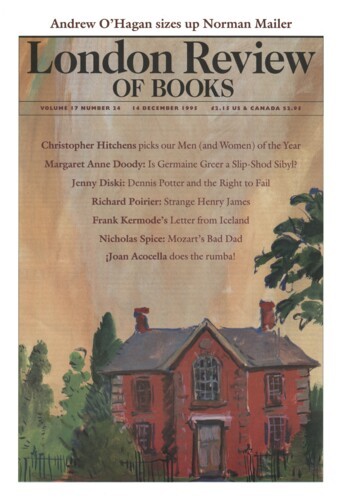
Nicholas Spice, 14 December 1995

I notice that I often hold back from Mozart’s music. When I listen to the opening of Haydn’s Creation – the ‘Representation of Chaos’ – I do not inhibit my feelings. Yet the opening of Mozart’s Dissonance String Quartet (K.465, in C), which, as Maynard Solomon intimates, may partly have inspired Haydn’s vision of loss, leaves me comparatively unmoved. And it is the same with the String Quintet in G minor (K.516) and the Fantasy in C minor (K.475) and the B minor Adagio (K.540). In the face of these pieces I am like Coleridge gazing at the stars and the crescent moon in the western sky: ‘I see them all so excellently fairy/ I see, not feel, how beautiful they are!’’

Hubbub

Nicholas Spice, 6 July 1995

Around eleven o’clock on Monday morning, I phone Dell Computers to query an invoice, but the accounts department is engaged, so I get put through instead to the development section of the first movement of the New World Symphony. The music I intrude on is intense and self-absorbed. I am like a child in a children’s book who has stumbled through a gap in reality and fallen headlong into another world. I pick myself up and follow Dvorak’s gangly, adolescent theme as it strides from instrument to instrument and key to key on its way home to the tonic. I think of it as healthy, wide-eyed and affirmative, trumpeting an ingenuous faith in energies which will lead to a new world far braver than any Dvorak might have imagined, the world of Dell Computers in Bracknell, of fax-modems, of the Internet, of telephones capable of pouring Dvorak’s impassioned certainties into the ears of office workers on humdrum Monday mornings.

Inspector of the Sad Parade

Nicholas Spice, 4 August 1994

The Gulf of Paria, Naipaul’s mediterrnanean, lies between the coast of Venezuela and the island of Trinidad. The water is almost encircled by land, with only two outlets to the wider ocean. Here, on the Venezuelan side, close to the mouth of the Orinoco, the Destiny lay at anchor, while on board Raleigh watched for the outcome of his last doomed expedition to discover El Dorado. Two hundred years later, across the Gulf in Port of Spain, the exiled revolutionary Francisco Miranda languished for a year, as hope of relaunching his invasion of Venezuela dwindled and with it his credibility and self-respect. Raleigh and Miranda: ‘obsessed men, well past their prime, each with his own vision of the New World, each at what should have been a moment of fulfilment, but really near the end of things, in the Gulf of Desolation’.

With more than eight hundred high-grade items to choose from, London Reviews gets the number down to just 28. But already it is the third such selection from the London Review of Books. Is three...

Read more reviews

Read anywhere with the London Review of Books app, available now from the App Store for Apple devices, Google Play for Android devices and Amazon for your Kindle Fire.

Sign up to our newsletter

For highlights from the latest issue, our archive and the blog, as well as news, events and exclusive promotions.

Newsletter Preferences